

GEOPASS · Geomechanics and wellbore stability
Find the minimum mud weight that keeps the hole open.
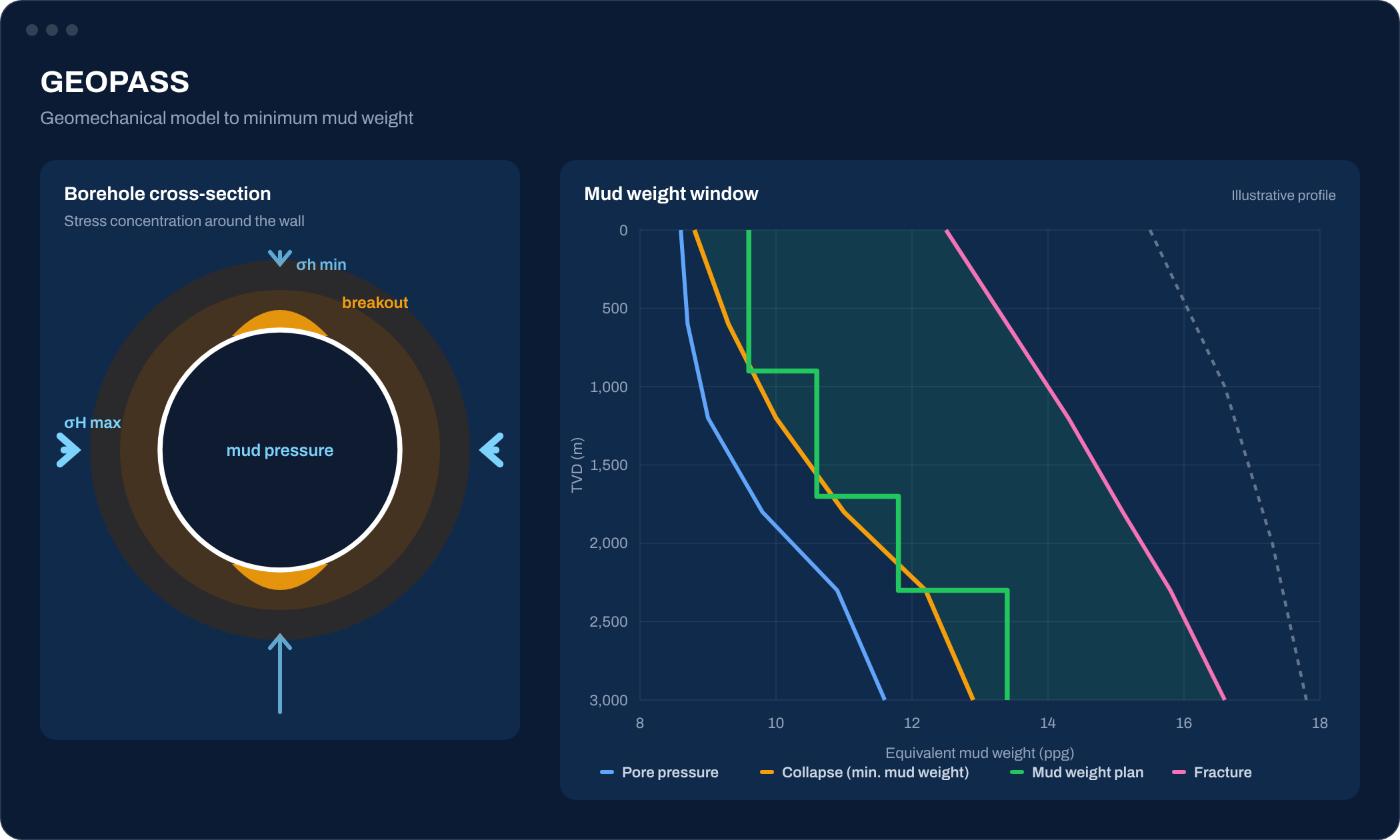
Too light and the wall caves in. Too heavy and the formation fractures. GEOPASS models the stresses around your borehole and shows the safe mud weight window, depth by depth.
From well data to a mud weight you can defend
Build the model
Overburden, pore pressure, rock strength and horizontal stresses from logs, calibrated with pressure tests, leak-off tests and core data.
Calculate the wall stresses
Stresses around the borehole for the planned inclination and azimuth, checked against a rock failure criterion.
Choose the mud weight
Collapse pressure, minimum mud weight and fracture limit along the well, compared with your mud weight plan.
What GEOPASS gives you
Collapse pressure
The minimum mud weight that prevents shear failure of the borehole wall.
Mud weight window
Pore pressure, collapse, fracture and overburden on one depth plot.
Well path sensitivity
See how inclination and azimuth change the safe window before you fix the trajectory.
Casing point support
Spot the depths where the window narrows and a casing point may be needed.
Calibrated to offset wells
Compare the model with caliper, breakouts, cavings and losses seen in offset wells.
Report-ready output
Plots and tables for the drilling program and the basis of design.
The science behind it
Built on doctoral research in wellbore stability
GEOPASS comes from our founder's doctoral research on wellbore stability for mud weight determination, and from years of teaching petroleum engineering. It applies established rock mechanics in a workflow that drilling engineers can follow and check.
- Transparent inputs and assumptions
- Results reviewed by a qualified engineer before use
- Academic licensing for courses and theses

GEOPASS questions
What data does GEOPASS need?
At minimum density and sonic logs with the well trajectory. Pressure measurements, leak-off tests, caliper or image logs and core tests make the model more reliable.
Does it replace a full geomechanics study?
It speeds up the study and makes it repeatable, but results should always be reviewed by a qualified engineer before they are used for operational decisions.
Can universities use it?
Yes. Ask us about academic and class licenses for geomechanics and drilling courses.
Can you run the study for us?
Yes. Wellbore stability studies are part of our DEPC consulting service.
Talk to an engineer, not a sales script
Tell us about your well, your team or your class. We reply within one business day.